
Spanish peaceful transition of power from an aging dictatorship to a democracy is as fascinating as any other revolution. The same monumental revolutionary tasks were achieved in Spain by gradual shift of power within the legal landscape.
There are two aspects of peaceful transition of power from Franco to King Juan Carlos and eventual return to democracy in Spain:
One aspect is a political eventuality that moved Spain from rigidity of a tyranny to a more tolerant modern state.
Another aspect is a Law of Succession that created a legal structure for transfer of power years before the actual transition occurred.
Let’s examine how both themes paved a way for a democracy in Spain.
| Date | Event |
|---|---|
| 1936-07-19 | Military uprising in Barcelona – start of the Spanish Civil War |
| 1939-03-28 | Victorious Nationalists entered Madrid in triumph – the Spanish Civil War came to an end |
| 1947-03-28 | The first draft of Law of Succession (Ley de Sucesión en la Jefatura del Estado) declares Spain as a kiddom, and Franco has a right to name his royal successor. |
| 1948-11-08 | Franco did not want to deal with the legitimate heir Don Juan. He requested that Don Juan’s son – Juan Carlos would travel to Spain and be educated under Franco’s watchful eye. By an agreement with Franco, 10 year old Juan Carlos (son of Don Juan) traveled from Lisbon to Madrid on a train to be educated and nurtured as a proper Spanish heir after Franco’s death. |
| 1950 autum | Por a secret agreement between Franco and Don Juan (Count of Barcelona), Juan Carlos (12 years old) and his younger brother Infante Alfonso arrive to Spain to be groomed as future King of Spain after Franco. |
| 1956-03-29 | In a freak accident at Villa Giralda, in Estoril, Portugal while on schools vacation, Juan Carlos kills his young brother Infante Alfonso while playing with a .22-caliber pistol. |
| 1966-01 | In a statement to the U.S. news magazine Time, Juan Carlos affirmed his loyalty to his father declaring that he would never accept the crown while his father was alive. |
| 1969-07-15 | Franco privately informed Prince Juan Carlos de Borbón of his intention to officially designate him as his successor and the future king of Spain. |
| 1969-07-22 | 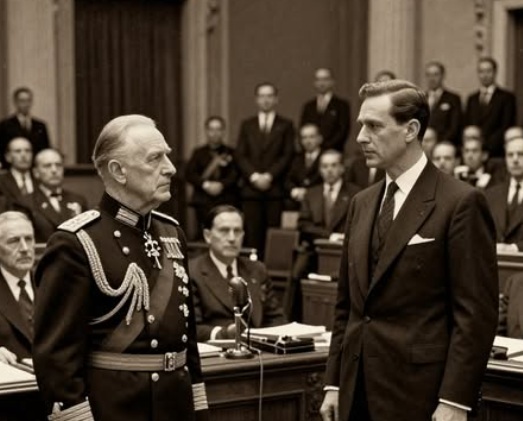 Franco proposes to Cortes Juan Carlos de Bourbon as Franco’s successor with a title of King. Don Juan (father of Juan Carlos) – a legitimate heir to the throne who lives in Lisbon is very displeased with the announcement. Meanwhile, Juan Carlos gets the title “Prince of Spain”. Franco proposes to Cortes Juan Carlos de Bourbon as Franco’s successor with a title of King. Don Juan (father of Juan Carlos) – a legitimate heir to the throne who lives in Lisbon is very displeased with the announcement. Meanwhile, Juan Carlos gets the title “Prince of Spain”.The was adopted at the Cortes with 491 for, 19 against and 9 abstentions. |
| 1974-04-25 | Peaceful Carnation Revolution in Lisbon, end of Caetano Government, end of Salazar’s era, and start of Portuguese eventual transition to democracy. |
| 1974-07-05 | Franco fells seriously ill and enters a hospital on July 9. Prime Minister Arias Navarro and President of the Cortes Rodríguez de Valcárcel to prepare a decree permitting Juan Carlos to take over as an interim Head of State while Franco is undergoing a life-threatening operation. Franco’s son in law tries to prevent signing of the decree. Finally, on July 19 Franco sing the decree. Now Juan Carlos would have to take responsibility for not his Government and not his Prime Minister. |
| 1974-09-02 | Franco resumes his powers |
| 1974-12-16 | Although political parties were banned since 1939, a new law allowing political associations was approved (Estatuto de Asociaciones Políticas) |
| Franco is planning to | |
| 1975-10-01 | Franco’s last public appearance. |
| 1975-10-15 | After experiencing symptoms of influenza Franco had a first hard attack |
| 1975-10-20 | Second heart attack of Franco. It is time to enact Article 11 of Ley de Sucesión, but Juan Carlos is hesitant. He doesn’t want another interim transition of power in the face of potential humanitarian crisis in Western Sahara. Morocco’s King Hassan prepares a 50,000 civilian march to overtake last Spanish possession in Africa – Western Sahara and army would have to shoot and kill civilians. |
| 1975-10 25-30 | Various sources stating that Franco permanently transfers his duties as head of state to Prince Juan Carlos. Juan Carlos becomes |
| 1975-10-30 | Franco displays sign of peritonitis. The doctors tell Juan Carlos that Franco has no chance of recovery. Franco requests implementation of Article 11 of Law of Succession. Juan Carlos becomes head of State for the second time. |
| 1975-10-31 | Juan Carlos chairs his first the cabinet meeting. The situation is most tense in Western Sahara, where 50000 civilians from Morocco advancing on Spanish troops and bloodshed seems inevitable. Juan Carlos travels to El-Aaiún near Moroccan border and calms the situation: we will have an organized withdrawal according to negotiated terms. The step consolidates military support to the Prince. Back in Madrid, a carefully orchestrated call from King Hassan II come in right during the cabinet meeting. This new Head of State firmly takes control into his hands. |
| 1975-11 03-06 | Franco goes through a series of extreme health episodes and more operations. The Franco’s family insisting on keeping Franco on life support. But questions on the political radar – who will be next Prime Minister and who will be lead the Cortes. The Prince communicates with active players, displays sound political skills and pursue his own political will. |
| 1975-11-05 | Juan Carlos acting as temporary head of state visits the Spanish Army (about 15,000 troops) in the Spanish Sahara. Juan Carlos gains first political dividends. |
| 1975-11-14 | One more heart operation for Franco and is barely alive. Spain signes an agreement with Morocco and Mauritania to transfer administrative control of the territory. Franco is not informed about loss of the last African colony. |
1975-11-20 |
Franco dies in Madrid at at 5:25 am. He was 82. King Juan Carlos becomes the Head of State. Few ministers are replaced, but Prime Minister and key Army ministers keeping their posts. |
| 1975-11-22 | Juan Carlos was proclaimed King. He held all the powers previously wielded by Franco, making him the most powerful King in Europe. Franco’s current Prime Minister, Carlos Arias Navarro stays in office. |
| 1975-12-02 | Very first appointment on new King. He appoints his former mentor Torcuato Fernández-Miranda to become the president of the Cortes – parliament of Spain. He replaces Alejandro Rodríguez de Valcárcel who was an old and open Franco appointee and supporter. He also leaves the powerful post of President of the Council of Regency. |
| 1975-12 04 | Juan Carlos confirms Carlos Arias Navarro as his Prime Minister. The visible “victim” from the previous (Franco’s) cabinet is Adolfo Suárez becomes Minister-Secretary General of the National Movement – leader of the only party in power. |
| 1975-12-06 | |
| 1976–04-26 | In an interview in the Newsweek King Juan Carlos I made the remark where he privately and famously referred to his current Prime Minister Carlos Arias Navarro as an “unmitigated disaster”. The Newsweek issue was strictly banned and censored in Spain, but reformist Spanish newspapers leaked and translated the King’s quote as “desastre sin paliativos,” making it a widely circulated political secret. |
| 1975-07-01 | After a lengthy power struggle existing Prime Minister of Spain appointed by Franco Carlos Arias Navarro finally forced to resigned |
| 1975-07-03 | Juan Carlos appoints young Adolfo Suárez as a Prime Minister. The young new Prime Minister is 43 years old. |
| . . . pending . . . | |
| . . . pending . . . | |
| . . . pending . . . | |
| . . . pending . . . | |
| . . . pending . . . | |
| . . . pending . . . | |
| . . . pending . . . | |
| . . . pending . . . | |
| 1976-07-05 | King Juan Carlos requests resignation of Franco’s Prime Minister Carlos Arias Navarro. New Prime Minister becomes In a surprise move, King’s selects as a new Prime Minister a personal friend and a successful functionary Adolfo Suárez who at that moment was secretary-general of the only legal political organization – National Movement. Both King and new Prime Minister begin to work on Political Reform Act that would legally change the political landscape on Spain. |
| 1976-11-19 | Old Cortes Generales largely appointed by Franco voted for general elections next year which means legally voted itself out of existence (for – 425, against – 59, abstained – 13). |
| 1981-02-23 | 18:23 Lieutenant-Colonel Antonio Tejero with 200 soldiers enters the Parliament where deputies are in process of approving new prime minister Leopoldo Calvo-Sotelo. The whole operation are |
| 1982-10-28 | General elections for the 2nd Cortes Generales – all 350 seats in Congress of Deputies and 208 of 254 seats in the Senate. Socialist party of Felipe González gained 48% of popular votes and 202 seats in Congress of Deputies. |
| 1982-12-02 | Felipe González – Secretary-General of the Spanish Socialist Workers’ Party (PSOE) becomes the first opposition leader to become a Prime Minister of Spain. |
(Visited 70 times, 1 visits today)
Be the first to comment